The National Magazine of RecordFounded San Francisco 1967 · New York since 1978
Tumbling Pebble
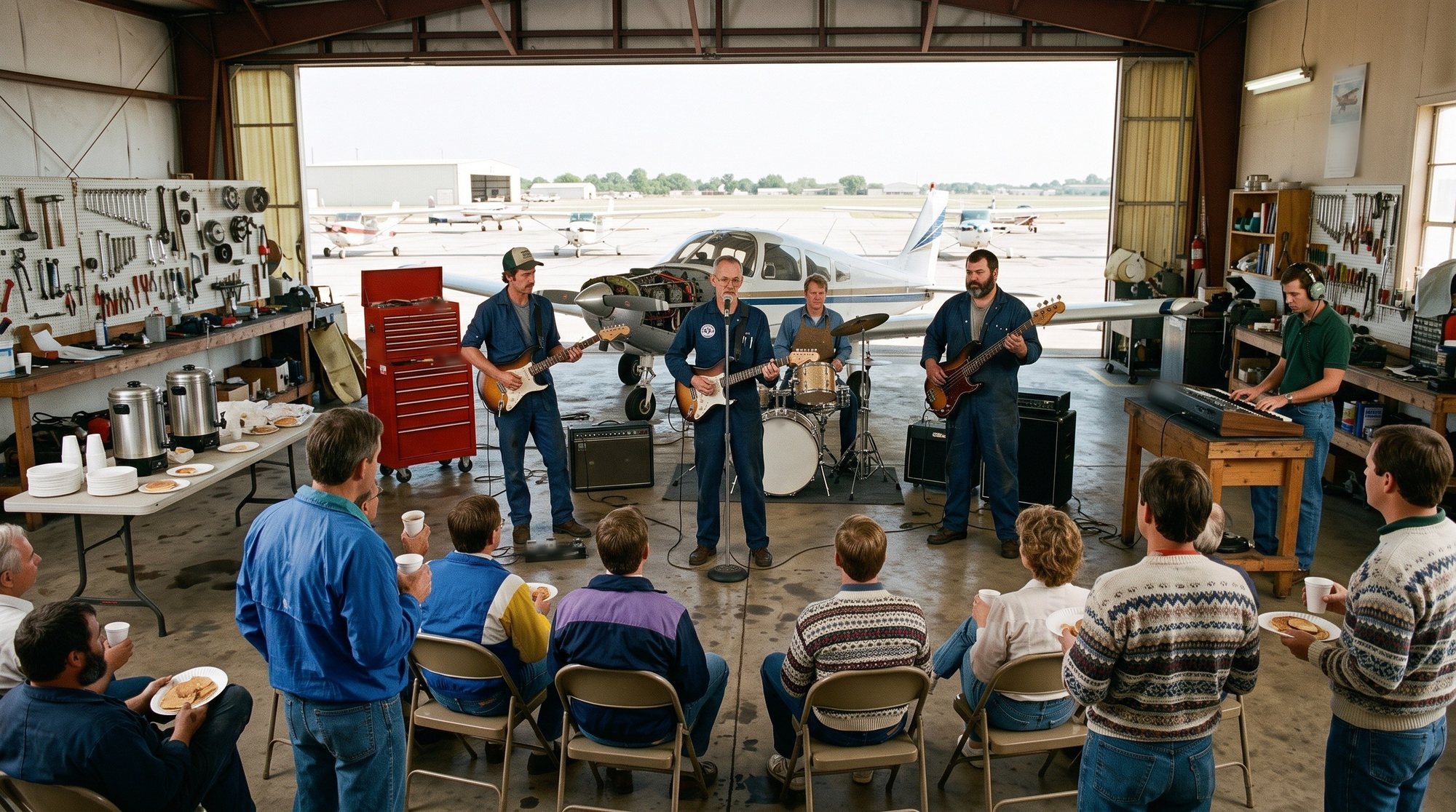
Mechanical performing in Hangar 4
Tumbling Pebble
No. 643June 18, 1992$2.95
  • Sass Master Flash: More Sass
  • The Reno Sessions
  • Forty minutes on three strings
MechanicalWithin Tolerance

Cover photograph courtesy of Mechanical.

No. 643 · Thursday, June 18, 1992 · $2.95

June 1992

Recovered by the archive September 26, 2026.

Contents

Feature

Mechanical

Within Tolerance

Five aircraft mechanics from Wichita tune to A440 because the manual says so, log every set to the tenth of an hour and have made the most exacting metal record of the year. They would like to discuss the B-flat.
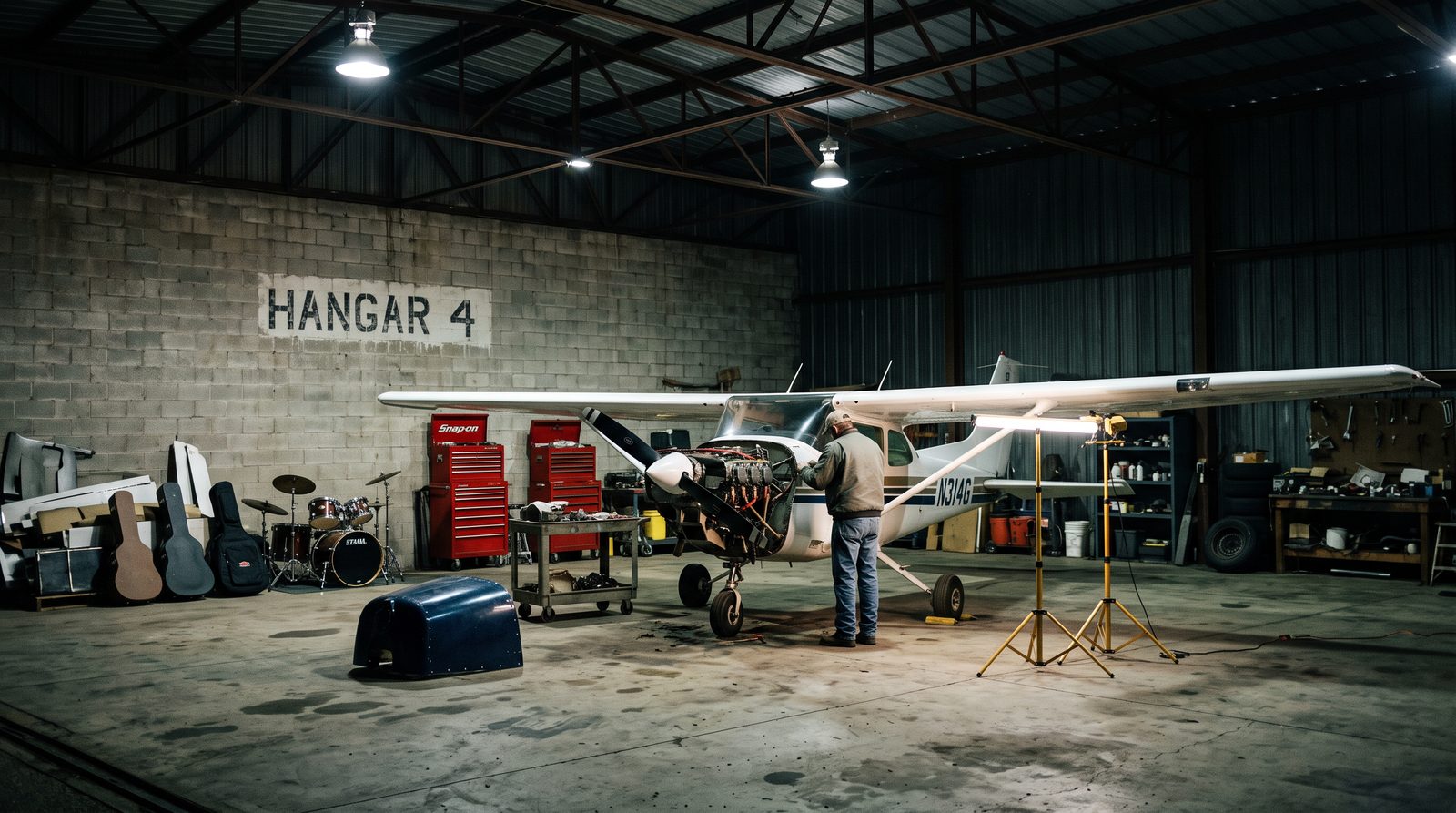
Hangar 4 at night with a light airplane inside
Hangar 4, Meridian Aircraft Service. Second shift. Photograph courtesy of Mechanical.

Hangar 4 at Meridian Aircraft Service sits off Jabara Airport on the northeast side of Wichita, a city that has built more airplanes than most countries own. When the second shift is over and the tools are back on the boards, a band sets up on the hangar floor between a single-engine airplane on jacks and the parts cage. The band is called Mechanical. Its members built nothing in this hangar. They fix what is brought in.

All five are certificated aircraft mechanics. One of them holds an inspection authorization, which means he can sign off work the others cannot, and he reminds them of it. None of them set out to start a band. In 1989, during a run-up to warm an engine before a compression check, the engine settled into a low, resonant drone. Del Krantz said, flatly, that it was a B-flat. Roy Vandersloot said it was not. The argument lasted most of a week, and at the end of it there were instruments in the hangar.

Krantz sings and plays rhythm guitar and holds a note the way he holds a torque wrench at the final click. Vandersloot plays lead, down-picking fast and even, his right hand like a rivet gun. Marlin Bemis, called Torque, plays bass and stands perfectly still. Wendell Pruett plays drums and locks the tempo to a tachometer in his head. Emmett Ostrander plays keyboards and runs the samples and the engine recordings, and stands a little apart from the others, which they say is because he is the only one of the five who leaves the ground. He holds a private pilot certificate. In a hangar, they explained, that is a distinction, and not entirely a compliment.

The band holds that music and maintenance are the same discipline practiced on different materials. A song, like an airframe, is either within tolerance or it is not. They tune to A440 because the manual says so. Every performance is logged to the tenth of an hour, the way time is logged on an engine, and the sheets are kept. The last set we saw ran 0.9. Krantz wrote it down before he put the guitar in its case.

Their new record is Airworthiness Directive, on Thrust Reverser Recordings. An airworthiness directive, for readers who do not spend their evenings in hangars, is the government's notice that a defect has been found in a type of aircraft or part and must be corrected, by a stated time, in a stated way. Compliance is not optional. The band does not present the record as optional either. It has four songs: "Magneto Drop," "Left Mag Only," "Carb Ice" and "Firewall." The first two concern the pair of independent ignition systems on a piston engine, which a pilot checks one at a time before takeoff, watching for a drop in engine speed that must stay within limits. "Carb Ice" concerns the ice that can form inside a carburetor on a warm, damp day and quietly starve the engine. It is the most frightening song on the record and has no words.

"There is no turbulence," Krantz said. "There is only insufficient understanding."

We asked Krantz about the weather. He said what the band says on stage between songs. "There is no turbulence," Krantz said. "There is only insufficient understanding." Ostrander, the pilot, has flown across the Flint Hills in July. He did not say anything. He did look at the floor for a moment.

The band plays union halls, a club in Derby run for and by the people who rivet, and this hangar, and almost nowhere else. They are not interested in touring. They have work in the morning. When we left, Bemis was coiling cables in the over-under manner and Pruett was sweeping. Vandersloot was still saying it was not a B-flat.
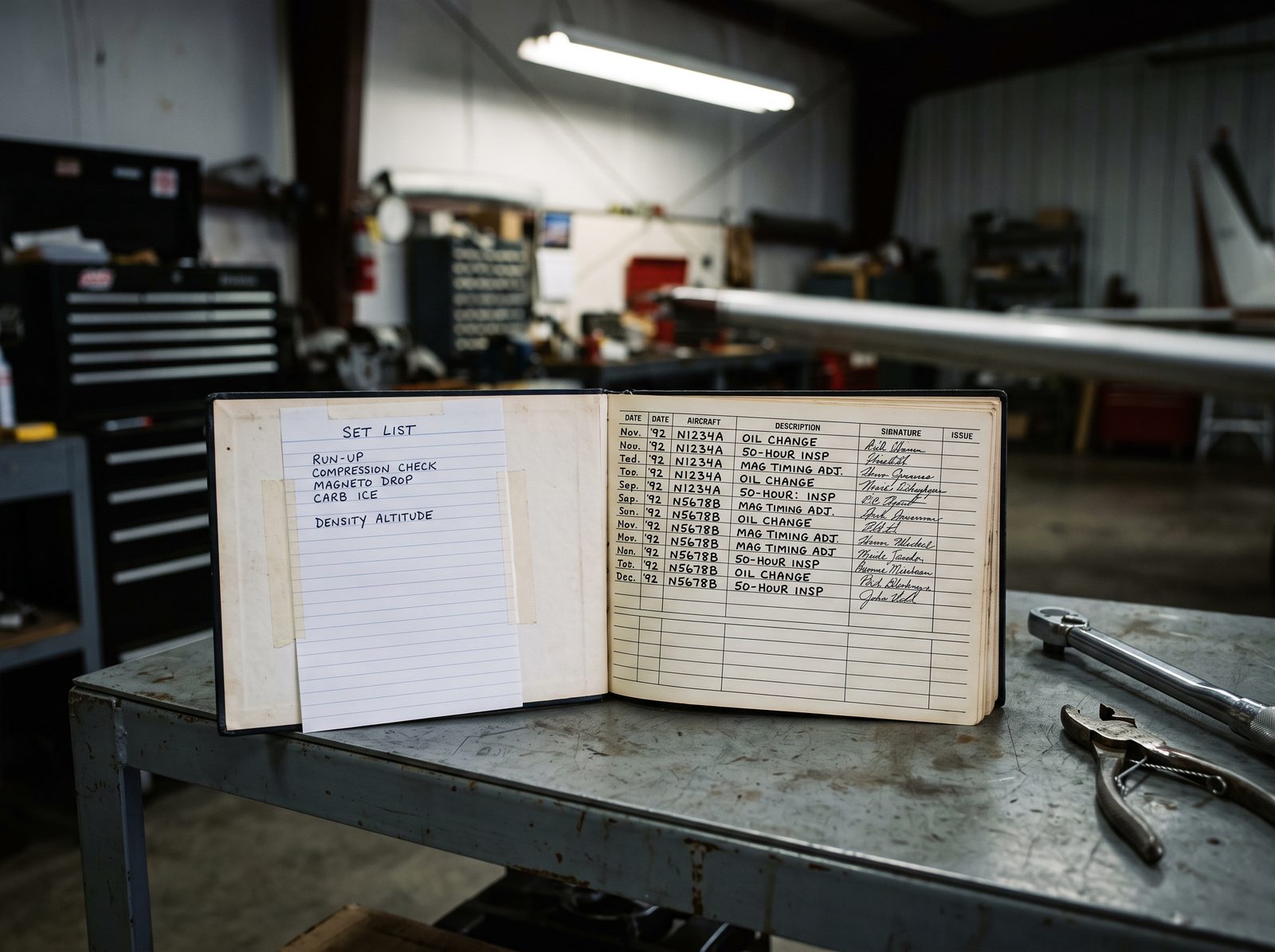
An open maintenance logbook
The logbook. Every set to the tenth of an hour. Photograph courtesy of Mechanical.

Records

Reviews in this issue. Stars as awarded.

Airworthiness Directive

Mechanical · Thrust Reverser · 1992

A mandatory record, in the band's telling, and in ours. Four songs from the Wichita mechanics, each one tighter than the last. "Magneto Drop" and "Left Mag Only" are a matched pair, the second running on half its ignition and still running clean. "Carb Ice" is an instrumental in which nothing happens loudly and everything goes wrong. "Firewall" closes the record at a volume best described as structural. Compliance was not presented as optional. We complied.

Frances Odegaard

Good Behavior

Incarcerated Kittens · Barbed Wire · 1992

The Huntsville, Texas, four-piece's most optimistic record. Two of the songs are in a major key. The band has not said which, and after several listens we are not certain either. Tammy Rhodes sings like she is reading a statement into the record; Carla Benavides plays slide on a glass whose origin, the band says, is not on file. "Porch Light," "Piney Woods" and "Letters from Conroe" are the warmest things they have done. "Parole Board Waltz" is the strangest and the best. Hard-rock blues with nothing to prove and a good deal to say.

Sam Teague

More Sass

Sass Master Flash · Flash in the Pan · 1992

Last year's debut from this Atlanta five-piece was described by several critics, though not by this magazine, as too much. More Sass is the answer. It has more. Tasha Merriweather raps with absolute control and does not raise her voice once, because she does not need to; Kendrick Holloway's turntables and Monique Battle's live bass give the band a weight most hip hop records this year can only sample. "Feedback Noted," "The Correct Amount" and "Dial It Back (A Refusal)" are the response. "Same Again, Louder" is the closing argument. We find it persuasive.

Teresa Vail

The Reno Sessions

Stompin' Kittens · Creep Show · 1992

Recorded live in Reno, Nevada. Why the Memphis rockabilly four-piece was in Reno, the sleeve does not say, and we did not ask. Darla Pruitt, Ruby Vance, Lou Ann Tate and Mae Ellison, who plays drums standing up, sing three-part harmony around one microphone and play like the floor is going to give out, which in Helena, Arkansas, it once did. "Two A.M. Set" and "Truckee River Stomp" are the new ones; "Heel Down (Reno)" and "Reverb Is God (Reno)" are better than the studio versions. Six songs. Not one too many.

Celia Marchbanks

Show Report

Forty Minutes on Three Strings

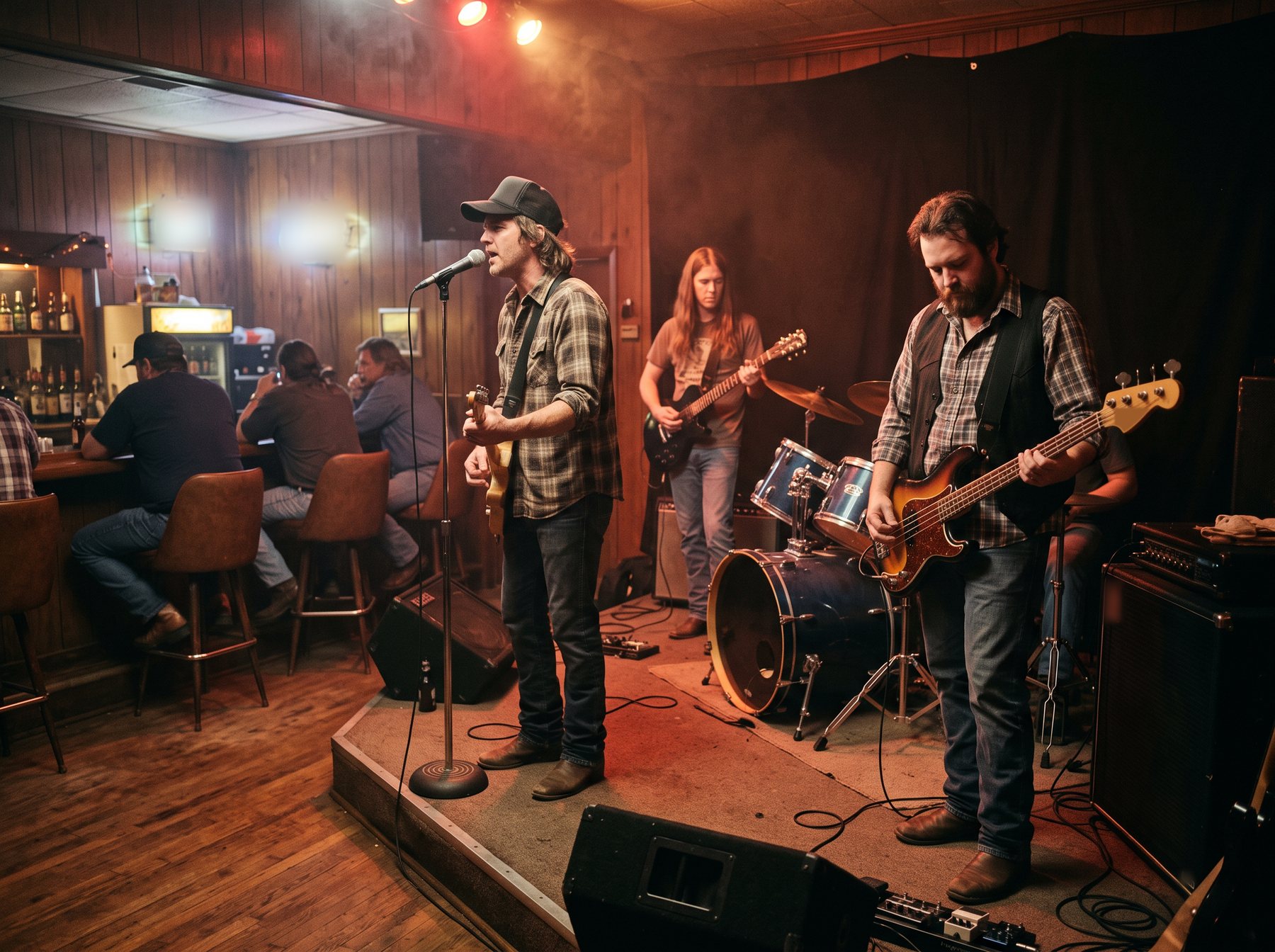
Quittin' Snakes playing a small room in Waycross, Georgia
Waycross, Georgia, 1992. Three strings. Forty minutes. Nobody mentioned it. Photograph courtesy of Quittin' Snakes.

Quittin' Snakes, a swamp-rock four-piece from Jacksonville, Florida, crossed the state line this spring for a Saturday in Waycross, Georgia. The band's equipment arrived in the bed of a pickup belonging to the singer's brother, James Durrence, who also handles the logistics, and who parked it close.

Early in the first song, lead guitarist Dale Conner broke a string, and then two more. He did not stop. He played the rest of the set, about forty minutes, on the three strings he had left. Bobby Ray Durrence sang as though nothing had happened. Nobody in the room mentioned it, and neither did the band, and neither, until now, did we.